

Last Updated: November 21, 2026
Quick Summary
To measure longevity treatment results, record a baseline first, then repeat the same tests under the same conditions and count only changes that exceed normal test-to-test variability and hold across two measurements. Track blood biomarkers, fitness tests, and home metrics against endpoints you set before treatment starts.
- A 2024 review describes longevity testing as iterative: initial measurement sets the baseline, later tests assess change.
- A longevity blood test shows biomarker levels at one moment but cannot prove a treatment caused an improvement.
- Home devices are for trends; the lab and clinic confirm the reading.
- The sitting-rising test is scored out of 10, deducting one point per support used.
- Twelve weeks is a reasonable first checkpoint for metabolic markers; strength and function often need longer.
Table of Contents
- Why Longevity Treatment Results Need a Baseline First
- What a Longevity Blood Test Can and Cannot Show
- Fitness Tests for Longevity That Track Function, Not Just Numbers
- Longevity Tests at Home for Consistent Repeat Measurement
- Reading the Sitting-Rising Test by Age
- Choosing Endpoints, Timelines, and What Counts as Real Change
- Inquire About Clinical Access and Your First Baseline Panel
- Frequently Asked Questions
Why Longevity Treatment Results Need a Baseline First
You cannot tell whether a longevity treatment is working if you never recorded where you started. That single principle separates useful measurement from guesswork, and it is where most longevity treatment programs quietly fail. A 2024 review of evidence-driven longevity medicine describes testing as iterative: the initial measurement sets the baseline, and subsequent regular tests assess change (Climbing the longevity pyramid review). (Source: standardized protocol)
At BioLife Science, we build every personalized plan around that first panel, because DNA, methylation, and biomarker data only mean something against a fixed starting point.
Baseline data does three jobs. It establishes your reference range for markers that fluctuate, it flags risk early, and it gives you a fair comparison six or twelve months later. Without it, a "great result" is just a number with no context.
Below, we show you exactly how to measure longevity treatment results across blood work, fitness, and home testing, and how to separate real change from noise.
What a Longevity Blood Test Can and Cannot Show
A longevity blood test shows where specific biomarkers sit relative to a reference range at one moment in time. It cannot, on its own, prove that a treatment caused an improvement. That distinction matters more than most clinics admit.
A 2025 paper from the Biomarkers of Aging Consortium in Nature identifies cardiovascular, metabolic, pulmonary, and physical-function measures among physiological biomarkers of aging (Biomarkers of Aging Consortium recommendations). In practice, that means a credible panel tracks glucose, C-reactive protein, blood pressure, and lipids alongside molecular markers.
What it cannot show is causation. Biological-age measures have documented limitations and should not be treated as definitive proof of treatment success. If you want to see how DNA, methylation, and biomarker data combine into a fuller picture, read our breakdown of personalized longevity planning, and for the methylation piece specifically, see methylation testing for longevity.
Fitness Tests for Longevity That Track Function, Not Just Numbers
Fitness tests for longevity measure what your body can actually do, which is why they often change before blood work does. The core set is short and repeatable.
- Grip strength: a hand dynamometer reading, repeated on the same hand each time
- Gait speed: timed walk over a fixed distance, same surface and footwear
- Chair stand test: number of sit-to-stands in a set interval
- Single-leg balance: seconds held, eyes open, both sides recorded
- Cardiorespiratory fitness: estimated VO2 max from a standardized protocol
Track each one in the same conditions. A 2026 healthy-aging survey from U.S. News & World Report ranked habits for longevity, brain health, and prevention, and the consistent theme is that function, not a single lab value, reflects how well you are aging.
Longevity Tests at Home for Consistent Repeat Measurement
Longevity tests at home are most valuable for consistency, not precision. A blood pressure cuff, a fitness band, and a daily step count give you a dense stream of data that a once-a-year lab draw cannot, but only if you understand what each device can and cannot resolve.
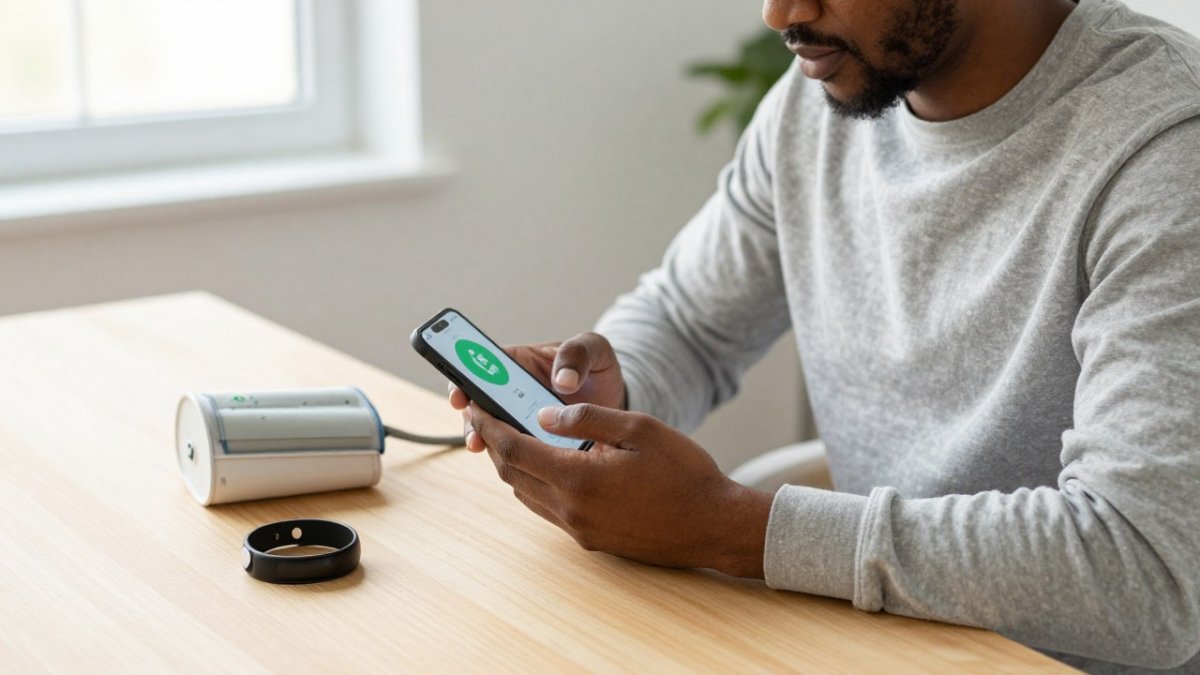
Home devices fall into three tiers of usefulness for a treatment program:
- Validated and clinically actionable: an upper-arm blood pressure cuff that has been validated to a recognized standard, and a home scale for weight trend. These map to outcomes a clinician will act on.
- Useful for trend only: resting heart rate, heart rate variability, sleep duration, and daily step count from a wearable. These fluctuate with stress, alcohol, illness, and travel, so compare weekly averages, never single days.
- Consumer-grade and directional at best: wrist-worn or finger-clip pulse oximetry, single-lead ECG features marketed as screening tools, and app-based "biological age" estimates derived from a few inputs. Treat these as engagement tools, not endpoints.
Measure at the same time of day, under the same conditions. Morning, fasted, seated for five minutes before the cuff goes on, arm supported at heart level, two readings a minute apart and averaged. Log daily steps and resting heart rate from wearable monitoring, then compare weekly averages rather than single days.
Why home data can mislead. A single home blood pressure reading can swing 10 mmHg or more between measurements in the same person, and wrist-worn heart rate sensors can drift during movement. That is not a reason to skip home testing, it is a reason to set a threshold for what counts as a change before you start, so an ordinary bad night does not get read as a treatment effect.
What home testing cannot replace. Home devices are for trends; the lab and the clinic confirm the reading. A cuff reading of 138/88 averaged over two weeks is a reason to bring the log to a clinician, not a diagnosis.
A practical home protocol. Pick no more than four home metrics tied to your treatment question. Fix the device, the time, and the body position. Log into one place, a spreadsheet or the device app, and review weekly averages at each follow-up. If you change devices mid-program, run both for one week so you have an overlap to calibrate against. Watch out: switching cuffs, bands, or apps partway through a program without an overlap period makes every prior comparison unreliable.
Reading the Sitting-Rising Test by Age
The sitting-rising test by age is a simple floor-to-standing movement scored out of 10, with one point deducted for each support used, such as a hand, forearm, or knee, and half a point deducted for each loss of balance.
There is no single official pass mark, and you should treat any age-based chart as a rough guide rather than a diagnosis. Use the score as one signal among several, not as a verdict.
How to administer it consistently. Start standing, cross your ankles, and lower yourself to the floor and back up with as little support as possible. Score each attempt, do two attempts, and record the better one.
What a change means for a treatment program. A score that drops between follow-ups signals a change worth discussing with a clinician, especially for anyone concerned about mobility and falls.
Safety and stopping criteria. The test is not appropriate for everyone.
Why it earns a place in the panel. The sitting-rising test is free, needs no equipment, and captures strength, balance, and coordination in one movement, qualities that matter for independence and that lab work does not reflect.
Choosing Endpoints, Timelines, and What Counts as Real Change
Real change is a shift that exceeds normal test-to-test variability and holds across two measurements. Pick your endpoints before treatment starts, not after, or you will end up rationalizing whatever number moved.
Set primary endpoints tied to your clinical question, secondary endpoints for context, and a review date. Twelve weeks is a reasonable first checkpoint for metabolic markers; strength and function often need longer. For the broader case for measuring healthspan rather than lifespan alone, see why healthspan is the new measure, and for turning baseline data into defined endpoints, our guide to building a personalized wellness plan walks through it.
| Measurement | Typical Interval | What Counts as Real Change |
|---|---|---|
| Blood biomarkers | 12 weeks | Shift beyond reference variability, confirmed twice |
| Grip strength | 8-12 weeks | Consistent gain across three readings |
| Gait speed | 8-12 weeks | Faster timed walk on repeat attempts |
| Home blood pressure | Weekly average | Sustained trend over four weeks |
| Sitting-rising score | 12 weeks | Change that holds at next follow-up |
Watch out: changing labs, devices, or test conditions mid-program makes comparison meaningless. Keep the method fixed.
Inquire About Clinical Access and Your First Baseline Panel
Measurement only works if someone interprets it in context. A panel of numbers without clinical judgment is a spreadsheet, not a plan.
BioLife Science combines regenerative science with a spa-like experience, and offers personalized health plans anchored in DNA and methylation testing. Our concierge-style care is designed to support you through your program. If you are ready to establish your own baseline, inquire for clinical access and start with a first panel built around your biology.
The hardest part of measuring longevity treatment results is not the test. It is committing to a baseline, repeating the same measurements, and reading change honestly. BioLife Science can help you do all three, with personalized plans anchored in DNA and methylation testing, a credential-verified sourcing program, and concierge-style care across our network of wellness destinations. Get started with BioLife Science and build a baseline you can actually measure against.
Frequently Asked Questions
What is the #1 predictor of longevity?
No single measure predicts lifespan on its own, and research on aging biomarkers treats longevity as multidomain. Cardiovascular fitness, measured as VO2 max or cardiorespiratory fitness, is among the strongest functional signals, which is why it appears in most longevity test batteries. A 2025 paper in Nature on physiological biomarkers of aging lists cardiovascular, metabolic, pulmonary, and physical-function measures as core domains. Use one metric as an anchor, but judge longevity treatment results against a panel of measures rather than a single number.
Which biomarkers can help track longevity treatment results?
A practical panel includes blood biomarkers such as glucose, C-reactive protein, and blood pressure, plus functional measures like grip strength, gait speed, and cardiorespiratory fitness. The 2025 Biomarkers of Aging Consortium recommendations in Nature group cardiovascular, metabolic, pulmonary, and physical-function measures as physiological biomarkers of aging. The key is repeatability: run the same longevity blood test at the same lab on a consistent schedule so you compare like with like. Your clinician decides which markers fit your history and goals.
How often should you measure biomarkers during a longevity program?
A 2024 review of evidence-driven longevity medicine describes testing as iterative: an initial measurement sets the baseline, and subsequent regular tests assess change. The right interval depends on the marker. Blood pressure and body composition can be checked more often than a full laboratory panel, and fitness tests every few months give a clearer trend than weekly retesting. Agree on the schedule with your clinician before starting, and keep the timing, lab, and conditions consistent so test-to-test variability does not masquerade as progress.
Can at-home longevity tests show whether a treatment is working?
At-home tests are useful for frequent, low-friction tracking of things like daily steps, resting heart rate, blood pressure, and sleep, and they help you build a dense baseline between clinic visits. They are weaker for proving a specific treatment caused a change, because home devices carry measurement error and many variables shift day to day. Treat home data as a trend layer and confirm meaningful shifts with clinician-ordered labs and functional tests. No single test measures longevity, so combine sources rather than relying on one device.
How long should a 70-year-old be able to stand on one foot?
Single-leg balance times vary widely by individual, and the research supplied here does not provide a definitive age-based cutoff, so avoid treating any single number as a pass or fail. What matters more is your own trend: if your single-leg stance time is shrinking over repeated checks, that is worth raising with a clinician, since balance and mobility feed into fall risk and independence. Test under the same conditions each time, barefoot on a hard floor, and record the best of a few attempts.
What are the four tests to see if you're aging well?
A reasonable four-part screen covers cardiovascular fitness such as VO2 max or a step test, metabolic health through glucose and related blood markers, musculoskeletal function through grip strength and the chair stand test, and balance and mobility through gait speed and single-leg stance. These map to the physiological biomarker domains described in the 2025 Nature recommendations. Add a longevity blood test for inflammatory markers like C-reactive protein. The combination gives a fuller picture than any one test, and repeating the same four on a schedule shows direction of change.
